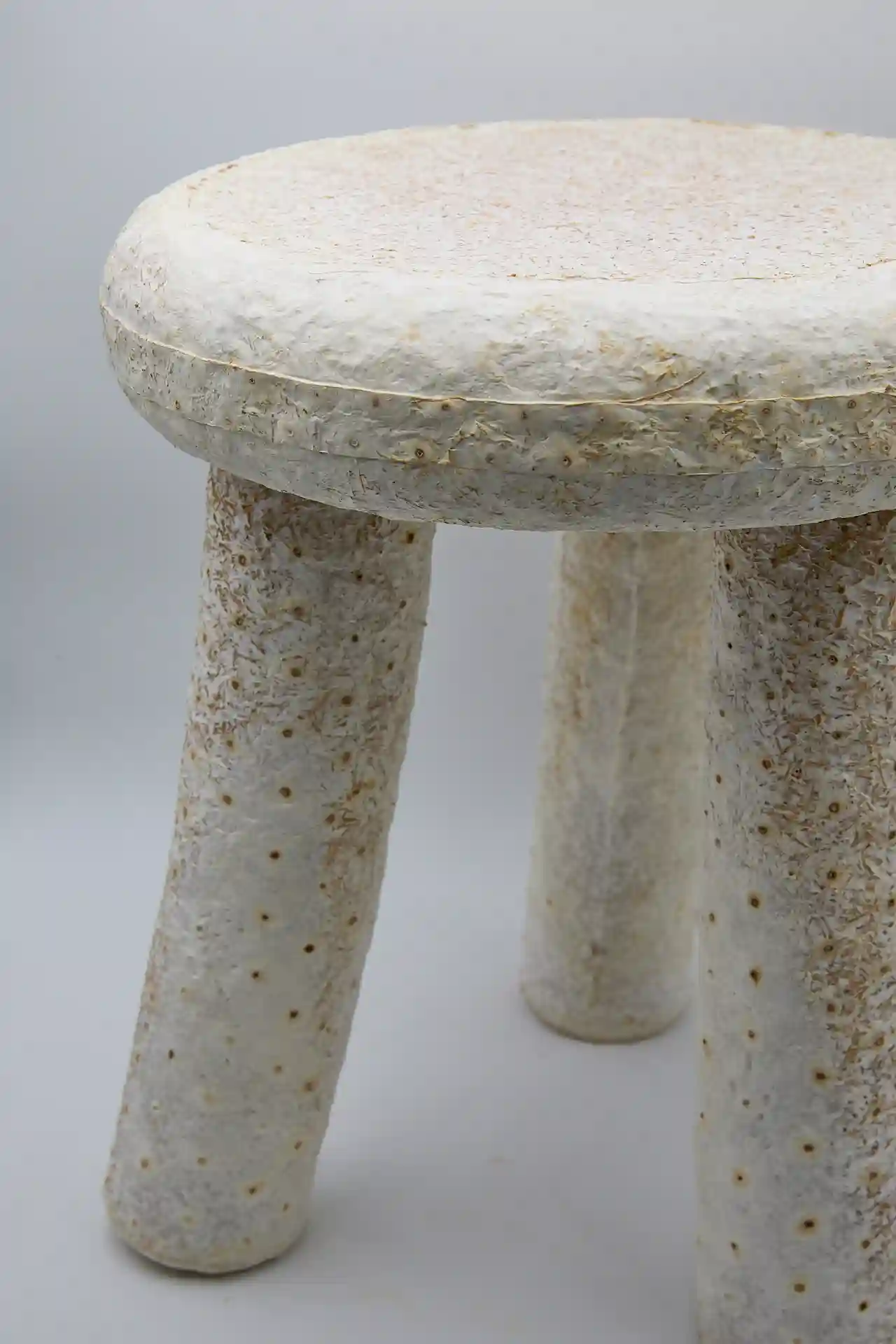
© Adrian Deweerdt
LoopOfFun
LoopOfFun is an interdisciplinary European project that develops a conceptual and technological methodology for the production of fungal-based materials.
Since 2022, Atelier LUMA has been involved in the European research project LoopOfFun, funded by the European Innovation Council (EIC). This program brings together an international consortium including the INM Leibniz Institute for New Materials (Germany), the Fraunhofer Society (Germany), the University of Groningen (Netherlands), and the National Institute of Chemistry (Slovenia), with the aim of developing a new generation of living materials—Engineered Living Materials.
This consortium builds on the close complementarity between research institutions, technology centers, and design practitioners, enabling the integration of advanced scientific approaches with applied experimentation. This collaborative dynamic fosters the continuous exchange of data, protocols, and expertise among partners, strengthening the project’s capacity to innovate across multiple scales.
![]()
Mycelium as a material
Mycelium is the underground network of a fungus—the living organism of which the visible mushroom is only the fruit. Fungi act as highly efficient biofactories of remarkable diversity: nearly 100,000 species have been identified to date, while the true number is estimated in the millions. As producers of a wide range of bioactive compounds, they hold significant, largely untapped potential—particularly in the field of materials.
As it colonizes a substrate made of natural matter, mycelium gradually transforms into a solid material that is bio-based, lightweight, durable, and compostable.
While this principle is already being explored in research and applications, LoopOfFun aims to go further: developing materials with precisely defined and controlled mechanical and structural properties, resilient to environmental fluctuations and tailored to specific uses. This innovation will be demonstrated through the production of two pilot materials at both centimeter and meter scales—one designed for structural applications, the other focused on pollutant degradation.
The methodological framework developed through this project is also designed to be transferable to other organisms and material systems.
Four research areas
The project is structured around four main pillars:
- Identification of fungal strains with enhanced properties for material synthesis
-
Development of genetically encoded sensors to read and write mechanical and structural properties
-
Development of a robotic platform for the efficient production of living materials and new growth protocols
- A holistic approach to product design
A collaboration between science and design
The scientific and design teams work in continuous dialogue: insights from experiments conducted at Atelier LUMA inform the genetic research carried out by project partners, who in turn refine the strains provided for fabrication testing.
/Pages%20%C3%A9dito/Atelier%20LUMA/Projets%20europ%C3%A9ens/211019-MYCELLIUM-ADRIANDEWEERDT-38.webp)
In the foreground, a mycelium strain; above it, a sunflower fiber substrate that supports its growth, ultimately forming the final material at the surface through this natural process.
Photo: © Adrian Deweerdt
The role of scientific partners
The consortium partners—including the INM Leibniz Institute for New Materials (Germany), the Fraunhofer Society (Germany), the University of Groningen (Netherlands), and the National Institute of Chemistry (Slovenia)—focus their work on fundamental research and the genetic modification of mycelium.
Their activities include:
-
Studying the genome of various fungal strains, including two from the Atelier LUMA archives, to identify those best suited to the project’s objectives
- Genetically modifying strains to guide their growth and development in response to external stimuli, particularly light wavelengths and mechanical pressure
- Developing biological sensors to monitor and regulate material properties in real time
/Pages%20%C3%A9dito/Atelier%20LUMA/Projets%20europ%C3%A9ens/251125-LUMA-ATELIERLUMA-LOF-ADRIANDEWEERDT-2996.webp)
From November 24 to 26, 2025, the LoopOfFun consortium gathered at LUMA Arles for a workshop dedicated to strains and substrates for mycelium-based materials.
Photo: © Adrian Deweerdt
The role of Atelier LUMA
As a design-driven laboratory, Atelier LUMA works in close complement to the scientific partners.
Its activities focus on:
-
Selecting and developing substrates using local resources such as agricultural waste and invasive plants from the Camargue
-
Designing molds and controlling the drying process, which halts mycelium growth to fix the object’s final form
-
Designing and testing production protocols in direct connection with the strains provided by scientific partners
-
Developing a reproducible production chain, tested through iterative design–build–test–learn cycles
-
Addressing the ethical questions raised by the use of living organisms as materials
-
Sharing and disseminating the project at a European scale
Atelier LUMA also develops experimental prototypes to test the real-world applications of these materials, particularly in design and furniture. It is currently working on a mycelium stool prototype, exploring the structural, aesthetic, and environmental qualities of this material in a domestic context.
Research rooted in Atelier LUMA’s practice
This research is directly connected to Atelier LUMA’s broader activities: valorizing local resources (agricultural waste, invasive plants), exploring natural dyes through its textile workshop, and developing more sustainable production scenarios.
![(c)arnaudmagnin_LUMA_LOF_20250926_11[73] (c)arnaudmagnin_LUMA_LOF_20250926_11[73]](https://luma.org/hs-fs/hubfs/0-Pages%20du%20site%20web%20(webp)/Pages%20%C3%A9dito/Atelier%20LUMA/Projets%20europ%C3%A9ens/(c)arnaudmagnin_LUMA_LOF_20250926_11%5B73%5D.webp?width=1333&height=2000&name=(c)arnaudmagnin_LUMA_LOF_20250926_11%5B73%5D.webp)
These mycelium stools are made from substrates derived from local resources, colonized by mycelium and grown in molds that define their shape. Once the growth process is complete, the material is dried to halt the development of the fungus and stabilize its structure.
Photo: © Arnaud Magnin
Collaboration within the consortium
The LoopOfFun project is built on close, ongoing collaboration between its partners, fostering an active exchange of knowledge, methods, and results. Through annual meetings, technical workshops, and joint participation in scientific and professional events, the consortium creates an interdisciplinary space where biology, chemistry, engineering, design, and fabrication intersect.
These regular gatherings, held across partner institutions in Arles, Groningen, Stuttgart, Saarbrücken, and Ljubljana, help align progress across the different work packages, compare experimental approaches, and strengthen connections between fundamental research and real-world applications. Workshops provide hands-on sessions focused on fungal strains, substrates, and production processes, supporting a shared understanding of challenges at multiple scales, from the microscopic to the macroscopic.
Some initiatives developed within the project explore expanded forms of collaboration at the intersection of research, design, and society.
The event Frugal Fungal, conceived by Atelier LUMA in collaboration with the restaurant La Chassagnette, is one such example. Through an immersive experience combining mycelium-based scenography, sensory exploration (seeing, touching, smelling), and mushroom tasting, the event opened the project to a broader audience of researchers, designers, architects, and local stakeholders.
/Pages%20%C3%A9dito/Atelier%20LUMA/Projets%20europ%C3%A9ens/240524-LUMA-AL-FUNGAL-ADRIANDEWEERDT-12.webp)
Focus on the scenography of the Frugal Fungal event, organized by Atelier LUMA and the restaurant La Chassagnette, combining mycelium structures and tasting to explore mycelium-based materials through the senses.
Photo: © Adrian Deweerdt
A selection of images and renderings from the LoopOfFun project
© Carlotta Borgato
© Arnaud Magnin
© Adrian Deweerdt
© Adrian Deweerdt
© Giacomo Frova
© Adrian Deweerdt
© Arnaud Magnin
© Adrian Deweerdt


Project partners:
Albert-Ludwigs-Universitaet Freiburg (coordination)
Rijksuniversiteit Groningen
Kemijski Institut
Fraunhofer Gesellschaft Zur Forderung Der Angewandten Forschung Ev
SAS LUMA/ARLES - LUMA Arles
The LoopOfFun Project has received funding from the European Union’s HORIZON-EIC-2021-PATHFINDER CHALLENGES programme under grant agreement No. 101070817.