
Open |
Open from
Closed today
Ticketing
My selection
Group show

Sensing the Future: Experiments in Art and Technology (E.A.T.)

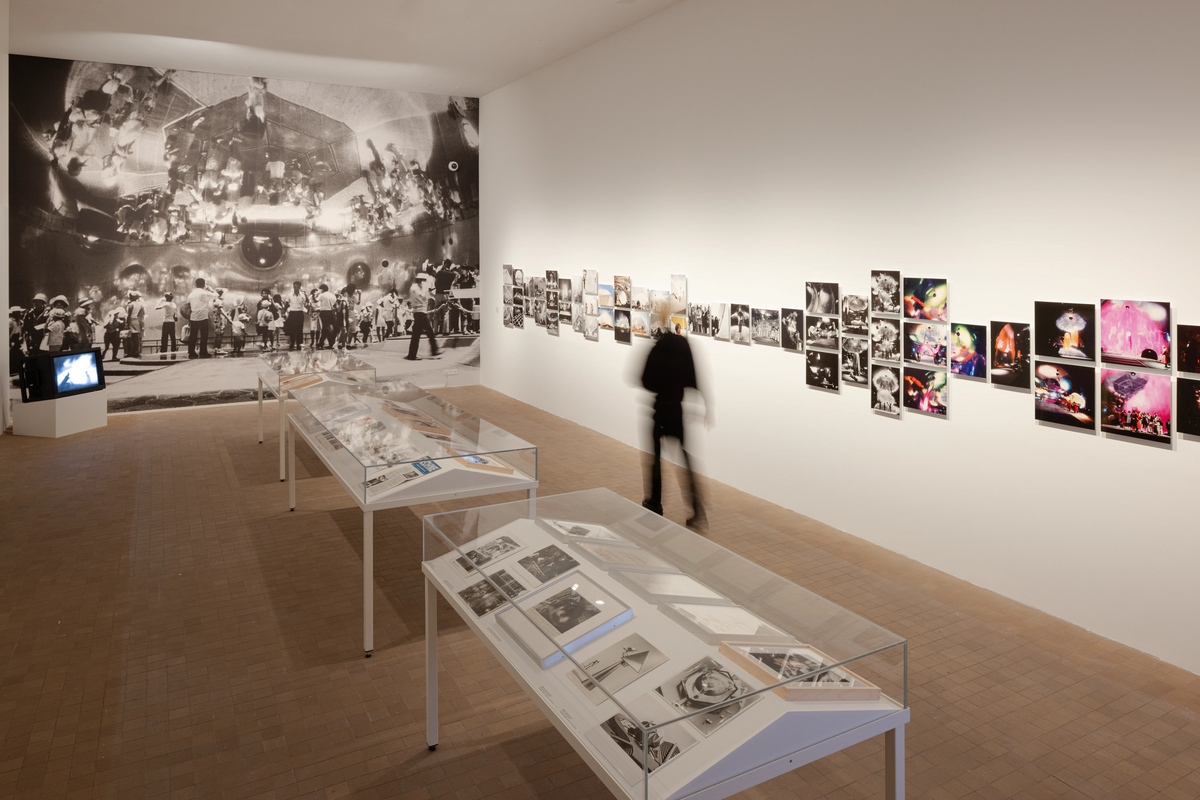
Sensing the Future: Experiments in Art and Technology (E.A.T.) is the first exhibition in France to focus on this landmark mid-twentieth century initiative, which brought together hundreds of key avant-garde artists and the engineers who ushered in the information age. 

E.A.T. was founded in 1966 in the U.S.A. by Billy Klüver and Fred Waldhauer, engineers at Bell Telephone Laboratories—then the world’s leading center for electronic innovation and telecommunications research—together with artists Robert Rauschenberg and Robert Whitman. Integrating theater, visual arts, multisensory environments, and groundbreaking technology, E.A.T’s pioneering cross-disciplinary efforts extended beyond the art world into social issues such as education and environmental sustainability. Echoing LUMA’s long-term research interest in the artist-led use of technologies, Sensing the Futureprovides unique insights into a foundational initiative whose influence on generations of artists continues to be central today.

Organized in partnership with the Getty Research Institute, the exhibition revolves around key elements of E.A.T.’s fabled history. Starting with an exploration of its beginnings, Sensing the Future also presents artworks and documentation from “9 Evenings: Theatre & Engineering” (1966), the Pepsi Pavilion at Expo ’70 in Osaka, Japan (1970), and “Projects Outside Art” (1970). At LUMA Arles, the exhibition features additional, rarely shown artworks as well as previously unpublished documentation, furthering the understanding of E.A.T’s pivotal role in contemporary art history.

With artworks by Robert Breer, John Cage, Lucinda Childs, Ivan Dryer, Jean Dupuy, Öyvind Fahlström, Hans Haacke, Alex Hay, Deborah Hay, Marta Minujín, Peter Moore, Forrest Myers, Fujiko Nakaya, Steve Paxton, Yvonne Rainer, Robert Rauschenberg, Lillian Schwartz, Harry Shunk & János Kender, Wen-Ying Tsai, David Tudor, Andy Warhol, Robert Whitman, and others.

As a part of the J. Paul Getty Trust based in the city of Los Angeles, the Getty Research Institute (GRI) is an international center for the study of visual culture and is home to one of the world's largest art libraries. Getty is a leading global arts organization committed to exhibiting, conserving, and understanding the world’s artistic and cultural heritage. Sensing the Future was among more than 60 exhibitions and programs presented across Southern California as part of the 2024 edition of PST ART, entitledArt & Science Collide, and presented by Getty. PST ART: Art & Science Collide followed Pacific Standard Time: LA/LA (September 2017–January 2018) and Pacific Standard Time: Art in L.A. 1945–1980 (October 2011– March 2012).

250430-LUMA-EAT-VICTOR&SIMON-VICTOR PICON-295 - Medium
Credits
E.A.T.'s Pepsi Pavilion at Expo '70, Osaka, Japan, 1970 March 18 Shunk-Kender
Getty Research Institute, Los Angeles, Gift of the Roy Lichtenstein Foundation in Memory of Harry Shunk and Janos Kender

In the press

The most ambitious exhibition in this slate is ‘Sensing the Future’
— Apollo


LUMA arles revisits E.A.T., the radical 1960s movement that fused art and technology
— Designboom

Exhibition images

250430-LUMA-EAT-VICTOR&SIMON-VICTOR PICON_V2-069
Credits
© Victor & Simon / Victor Picon
250430-LUMA-EAT-VICTOR&SIMON-VICTOR PICON_V3-081
Credits
© Victor & Simon / Victor Picon
250430-LUMA-EAT-VICTOR&SIMON-VICTOR PICON_V3-159
Credits
© Victor & Simon / Victor Picon
250430-LUMA-EAT-VICTOR&SIMON-VICTOR PICON_V4-312
Credits
© Victor & Simon / Victor Picon
250430-LUMA-EAT-VICTOR&SIMON-VICTOR PICON_V4-280
Credits
© Victor & Simon / Victor Picon
250430-LUMA-EAT-VICTOR&SIMON-VICTOR PICON_V4--2
Credits
© Victor & Simon / Victor Picon
250430-LUMA-EAT-VICTOR&SIMON-VICTOR PICON_V4-034
Credits
© Victor & Simon / Victor Picon
250430-LUMA-EAT-VICTOR&SIMON-VICTOR PICON_V4-019
Credits
© Victor & Simon / Victor Picon

Interview with Hans Haacke

"E.A.T. played a major role for artists who were the first to work with contemporary technology."

In this video, conceptual artist Hans Haacke looks back on his early experiments with E.A.T. He highlights the pivotal role of the collective, which opened up new ways for a generation of artists to blend art, interaction, and technological innovation.

Interview with Nancy Perloff

"I think the exhibition here is going to both enhance the story of E.A.T. and tell more stories, a greater story, a larger story."

In this video, Nancy Perloff, curator at the Getty Research Institute, presents the exhibition Sensing the Future: Experiments in Art and Technology.
She looks back at the origins and legacy of the collective E.A.T. (Experiments in Art and Technology), founded in 1966 to encourage collaboration between artists and engineers, and explores its pioneering role in the dialogue between art, innovation, and society.


Interview with Ming Tsaï

Ming Tsai, the son of artist Wen-Ying Tsai, retraces his father’s journey as a pioneer of kinetic and cybernetic art. He reflects on his father’s departure from China, his early career at MoMA in the 1960s, his involvement in the E.A.T. (Experiments in Art and Technology) movement, and his lifelong commitment to creating art that is both interactive and socially engaged.

Interview with Marta Minujín

"My thinking is "Live in art, not look at art.""

In this video, artist Marta Minujín reflects on the creation of her interactive work Minu-Phone.
She explains how, inspired by her belief that “we should live in art, not look at art,” she imagined a sensory experiencein which technology becomes a means of direct participation.
Through the collective E.A.T. (Experiments in Art and Technology), she collaborated with a robotics engineer to design an electronic phone booth that responds to users’ voices and gestures through light, color, and sound.
At the time, the work was praised for its boldness and for Minujín’s unique position as a female artist from Argentina.

The exhibition is organized by LUMA Arles in partnership with the Getty Research Institute.

At LUMA Arles, the exhibition is organized by Simon Castets, Director of Strategic Initiatives, Vassilis Oikonomopoulos, Artistic Director, Fabian Gröning, Project Manager for Strategic Initiatives, Martin Guinard, Curator.

​​​​​​​At Getty Research Institute, the exhibition was organized by Nancy Perloff, Curator, Megan Mastroianni and Andrew Park, Research Assistants, Alex Jones, Curatorial Assistant, Daniela Ruano Orantes, Curatorial Project Assistance.