Herstory
- Painting |
- Visual art |
- Photography |
- Sculpture
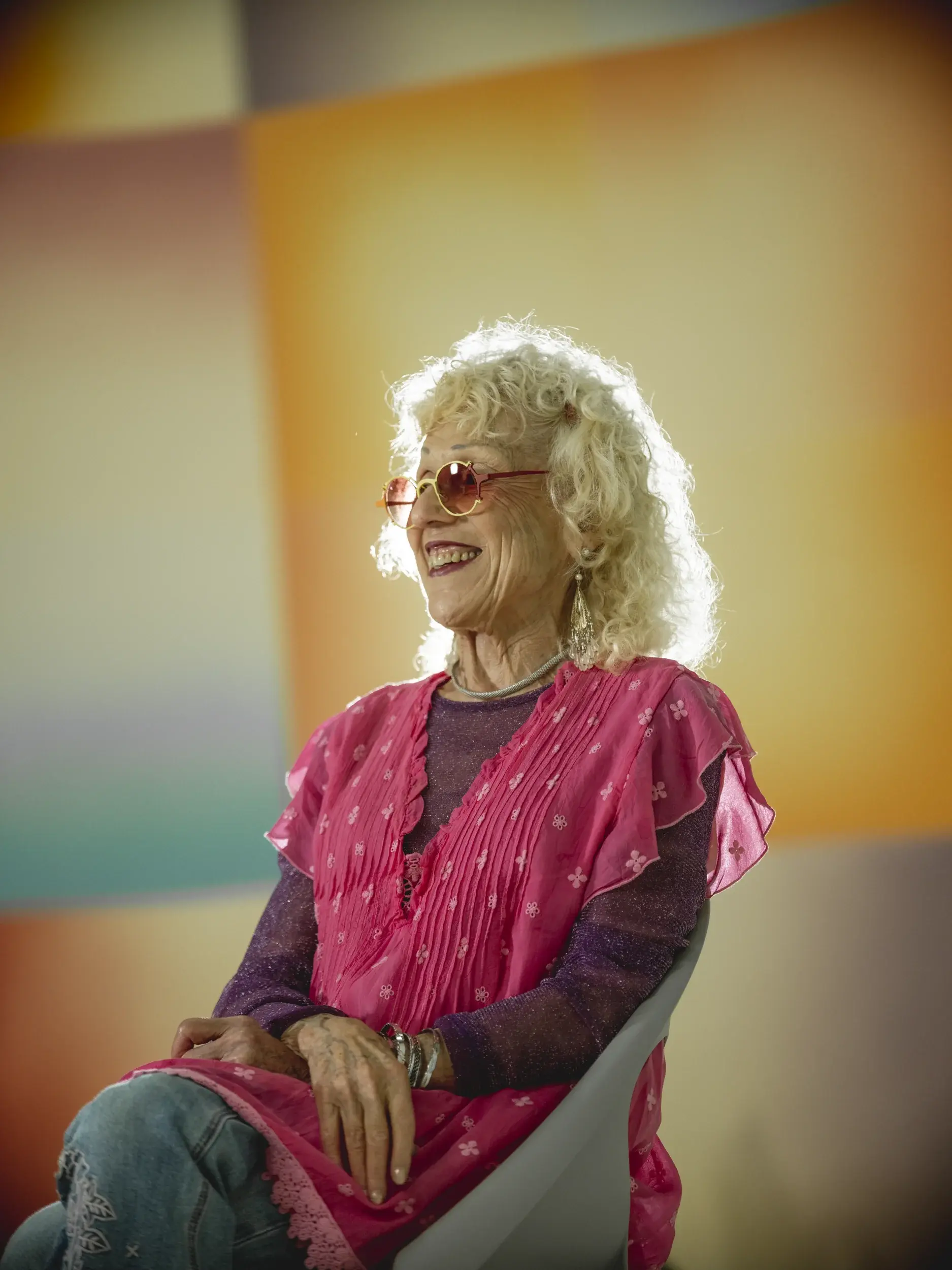
Spanning the full breadth of her sixty-year career, Judy Chicago: Herstory showcases the tremendous impact that Judy Chicago has had on contemporary art.
From Chicago’s 1960s experiments in Minimalism and Earth art to her revolutionary feminist art of the 1970s and narrative series of the 1980s and ’90s, Herstory traces the full evolution of Chicago’s expansive vision. Chicago attained significant public recognition in the 1970s for the legendary project, The Dinner Party (1974–79)—a colossal ceremonial banquet honoring important women throughout history, which is permanently installed at the Brooklyn Museum, in New York. In the decades since, Chicago, a lifelong teacher and researcher, has extensively channeled her concerns with feminist pedagogy, women’s history, and historical preservation into numerous ambitious installations, research projects, educational programs, and alternative exhibition spaces. Herstory contextualizes such feminist methodologies within the many coeval art movements in which Chicago participated—and from which she frequently has been expunged—tracing the development of her work as it evolved and expanded to meet the urgency of the social changes taking place in America and in the world during her lifetime.
Born Judy Cohen in 1939, Chicago was raised in a progressive Jewish household where she developed a lifelong passion for art and social justice. After completing her studies at the University of California, Los Angeles in 1964, Chicago became one of few women to be involved in the California-based minimalist, op-art and geometric abstraction avant-garde movements. Like many of her peers, she became proficient in industrial techniques including spray-painting, fiberglass-casting, and pyrotechnics. By 1970, the purview of these formal and material interests intersected with mass social change; galvanized by the women’s liberation movement, she divested herself from her married name, adopting the surname “Chicago,” after her hometown. Combined in the exhibition space, Chicago’s revolutionary experiments with traditional notions of femininity, taboo eroticism, the social construction of the body, and the cultural biases of art history continue to make her one of the most influential artists of the post-war era.
"Judy Chicago: Herstory" is organized by LUMA Arles in partnership with the New Museum, with the support of Christian Dior Parfums.
"Judy Chicago: Herstory" originated at the New Museum, New York.
Lead sponsorship is provided by Dior. Major support is provided by Jordan Schnitzer/The Harold & Arlene Schnitzer CARE Foundation.
Additional support is provided by Sabrina Buell and Yves Behar, Jay Franke and David Herro, The Gladys Krieble Delmas Foundation, Grażyna Kulczyk Collection, Hill Art Foundation, Kathleen O’Grady / The O’Grady Foundation, Debbie and Mitchell Rechler, Judy Rechler, Samuel H. Kress Foundation, Margherita Stabiumi, Lisa Watson and Mike Krupka.
The exhibition was originally curated by Massimiliano Gioni, New Museum Edlis Neeson Artistic Director, Gary Carrion-Murayari, New Museum Kraus Family Senior Curator, Margot Norton, former New Museum Allen and Lola Goldring Senior Curator and current Berkeley Art Museum and Pacific Film Archive Chief Curator, and Madeline Weisburg, New Museum Assistant Curator, with Ian Wallace, New Museum Curatorial Assistant.
The exhibition at LUMA Arles is curated by Vassilis Oikonomopoulos, Director of Exhibitions and Programs.
Practical Information