Open |
Open from
Closed today
Ticketing
My selection

Hans-Ulrich Obrist Archives - Chapter 2: Etel Adnan

  • Visual art

A Leporello, several notebooks and watercolour drawings exhibited in Dubai in 2007 catalysed Hans-Ulrich Obrist’s long-term collaboration and friendship with the late Etel Adnan, one of the greatest poets and artists of our time. Obrist was magnetically drawn to the cosmic energy of her work and obsessively collected every publication he found. The first he read was Sitt Marie Rose (The Post-Apollo Press, 1977), her magnum opus on the Lebanese Civil War, which established Adnan as a significant political writer and one of the preeminent voices of feminist and peace movements.

Seeing her work then evoked in Obrist a similar feeling to discovering Paul Klee’s work as a teenager. Like Klee, Adnan was a polymath. Her practice could be linked to superstring theory; a Gesamtkunstwerk that has many dimensions and expands the notion of single disciplines: cartographies, drawings, films, notebooks, novels, paintings, plays, poems, political journalism, sculptures, tapestries, and teaching.

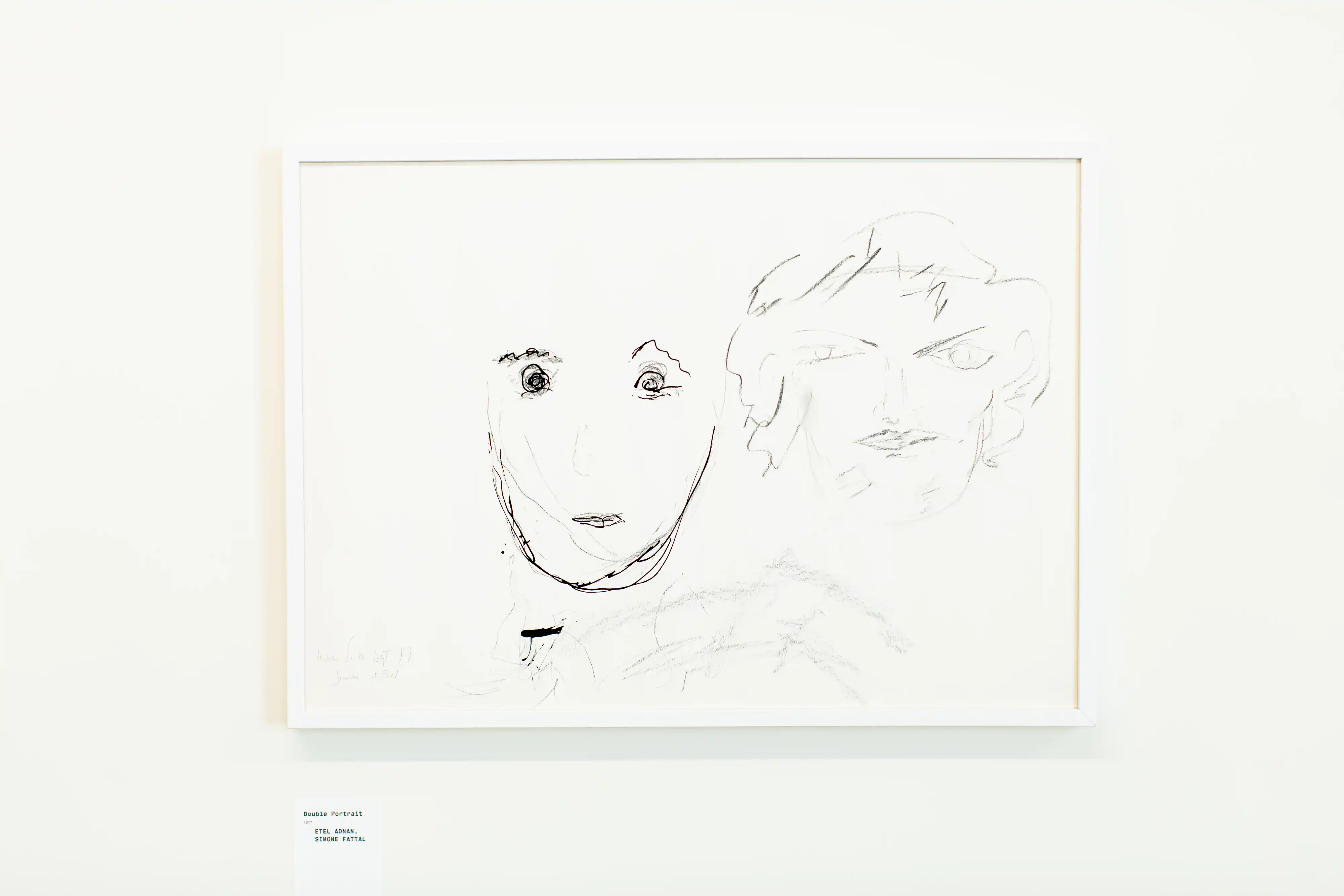
Born in Beirut in 1925, Adnan studied at Sorbonne and Harvard, after which she taught philosophy at the University and started painting in the late 1950s in California. There, she fell in love with her life partner Simone Fattal as well as a mountain, Mount Tamalpais, at the foot of which they lived. Her passion led to numerous paintings and the book Journey to Mount Tamalpaïs (The Post-Apollo Press, 1986). Often stemming from a red square, her canvases are abstract compositions with flat colours directly applied from the tubes. She was interested in the immediate beauty of colour. As Simone Fattal explains, her paintings both ‘exude energy and give energy. They shield you like talismans.’

Her unrealised project of becoming an architect can be compared to how she approached painting as something that is built. Adnan understood painting as addressing itself to the outside world and architecture as inescapable, something that is always already there and made for us to be. As she said, ‘the first architecture for a human being is their mother’s womb.’

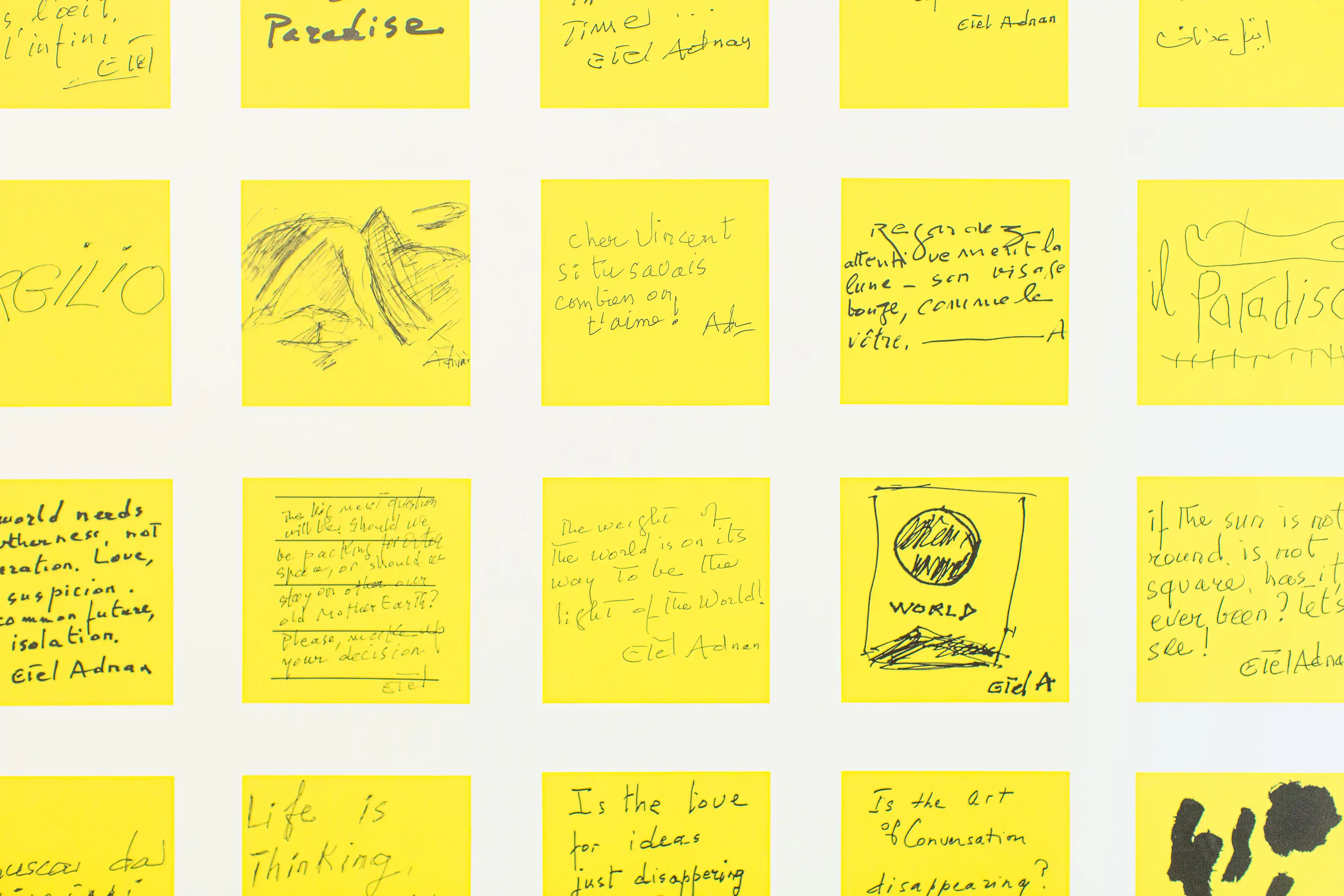
It was under heavy rain, during the winter of 2012, that Etel Adnan, Simone Fattal, Koo Jeong A, and Hans-Ulrich Obrist found refuge in a café in Brittany. Throughout long conversations, Adnan was writing poems on a notepad. It became evident to Obrist that it’s important to celebrate handwriting as opposed to the lamentation of its disappearing. Since then, he posts handwritten notes of the people he meets on Instagram once a day.

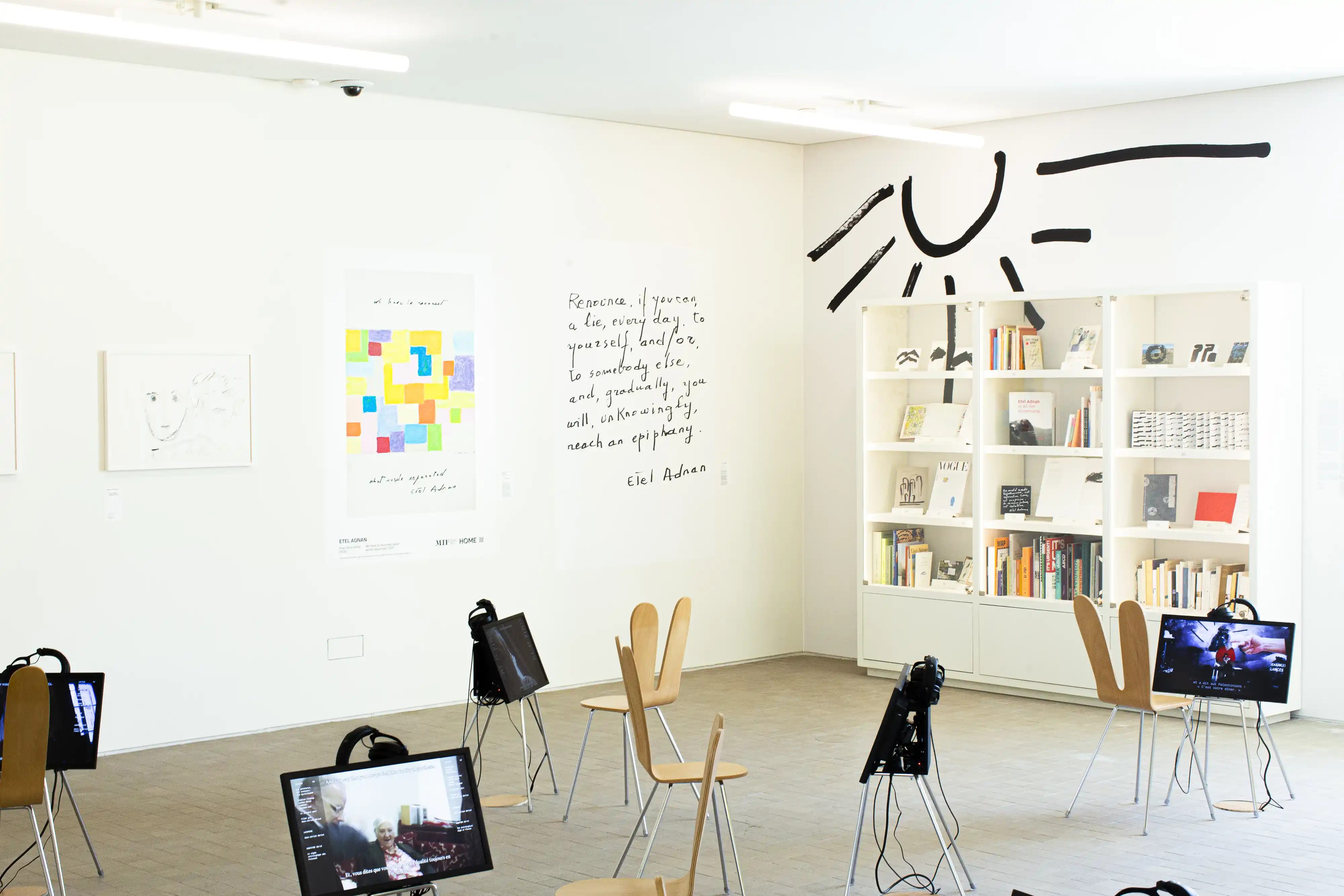
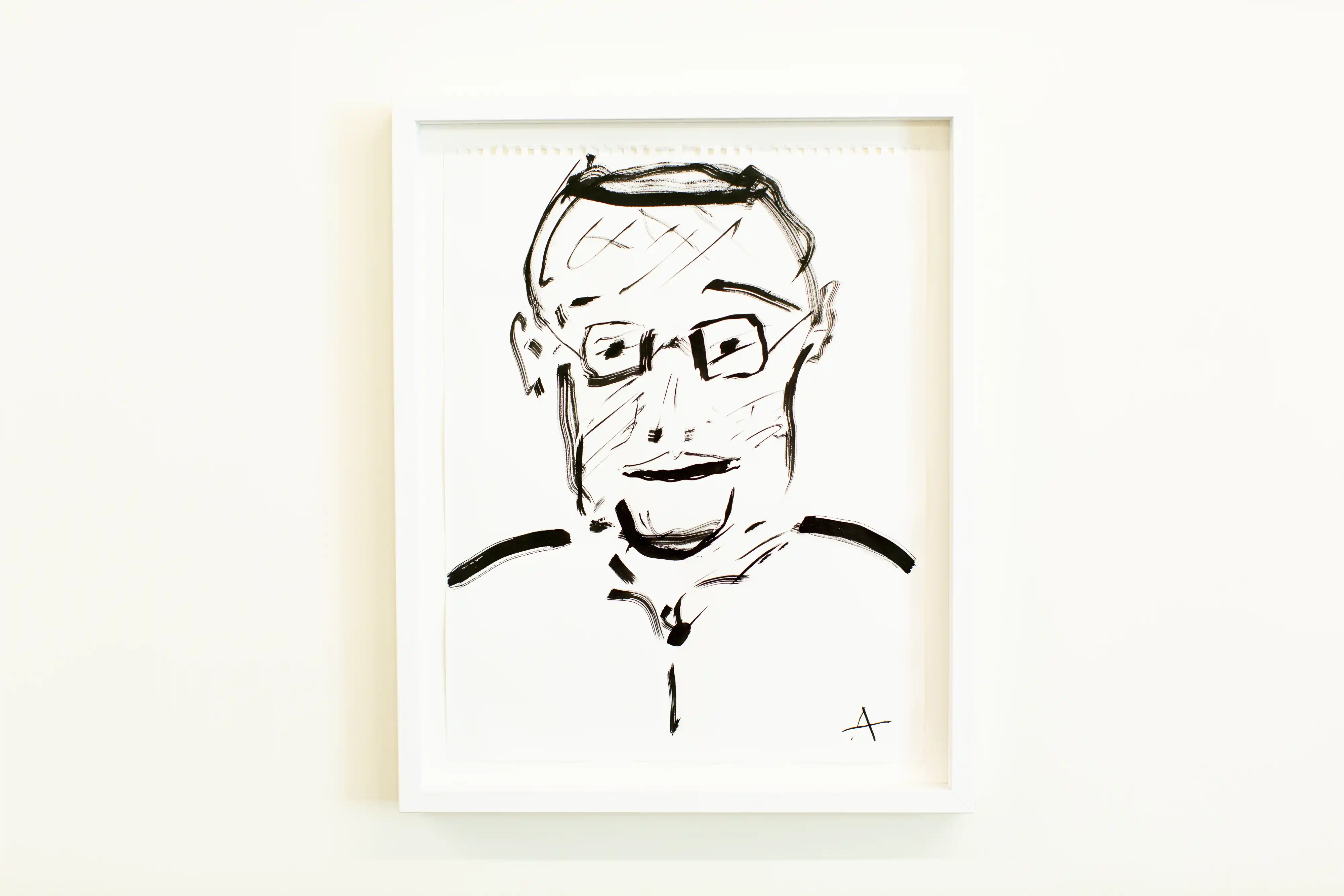
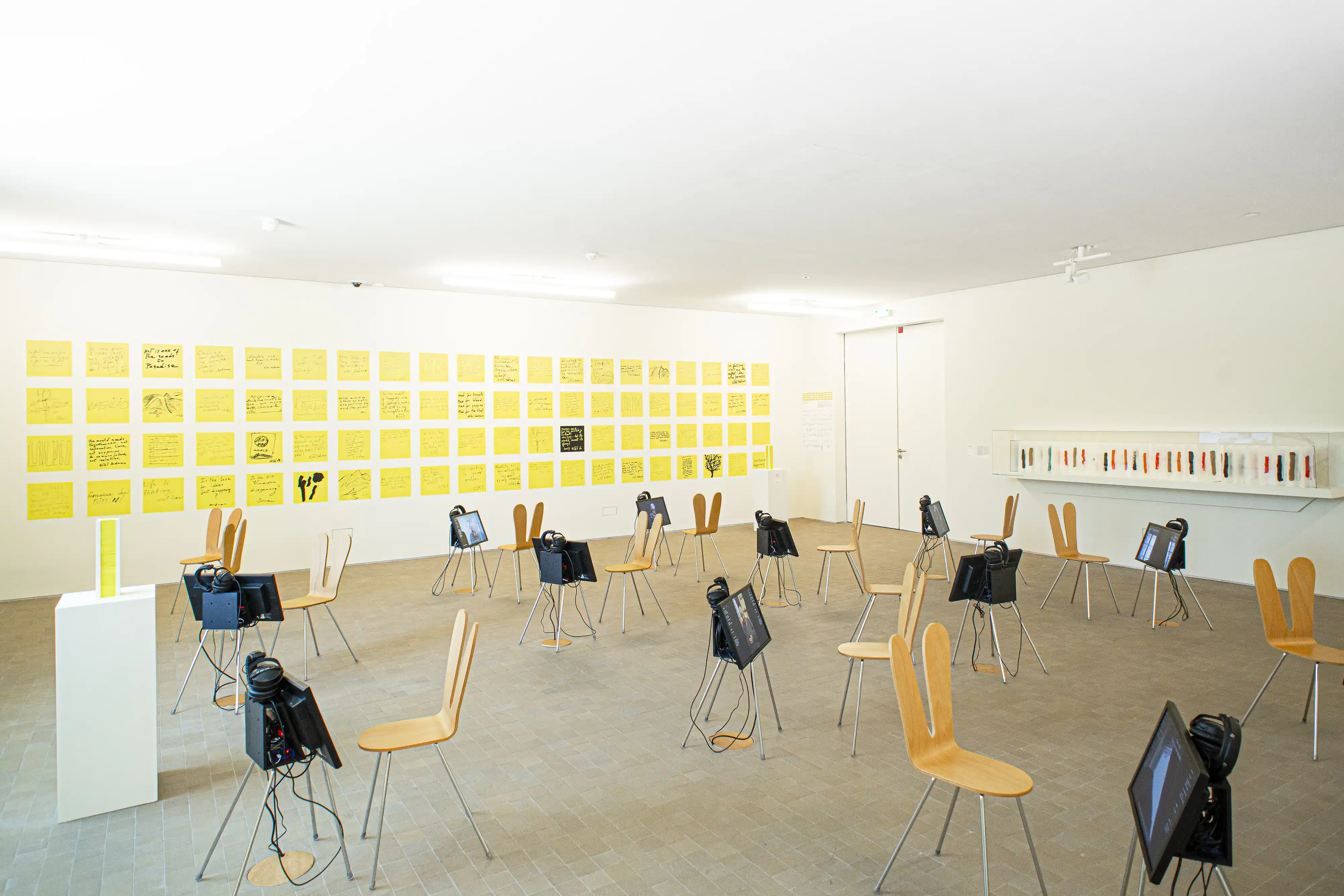
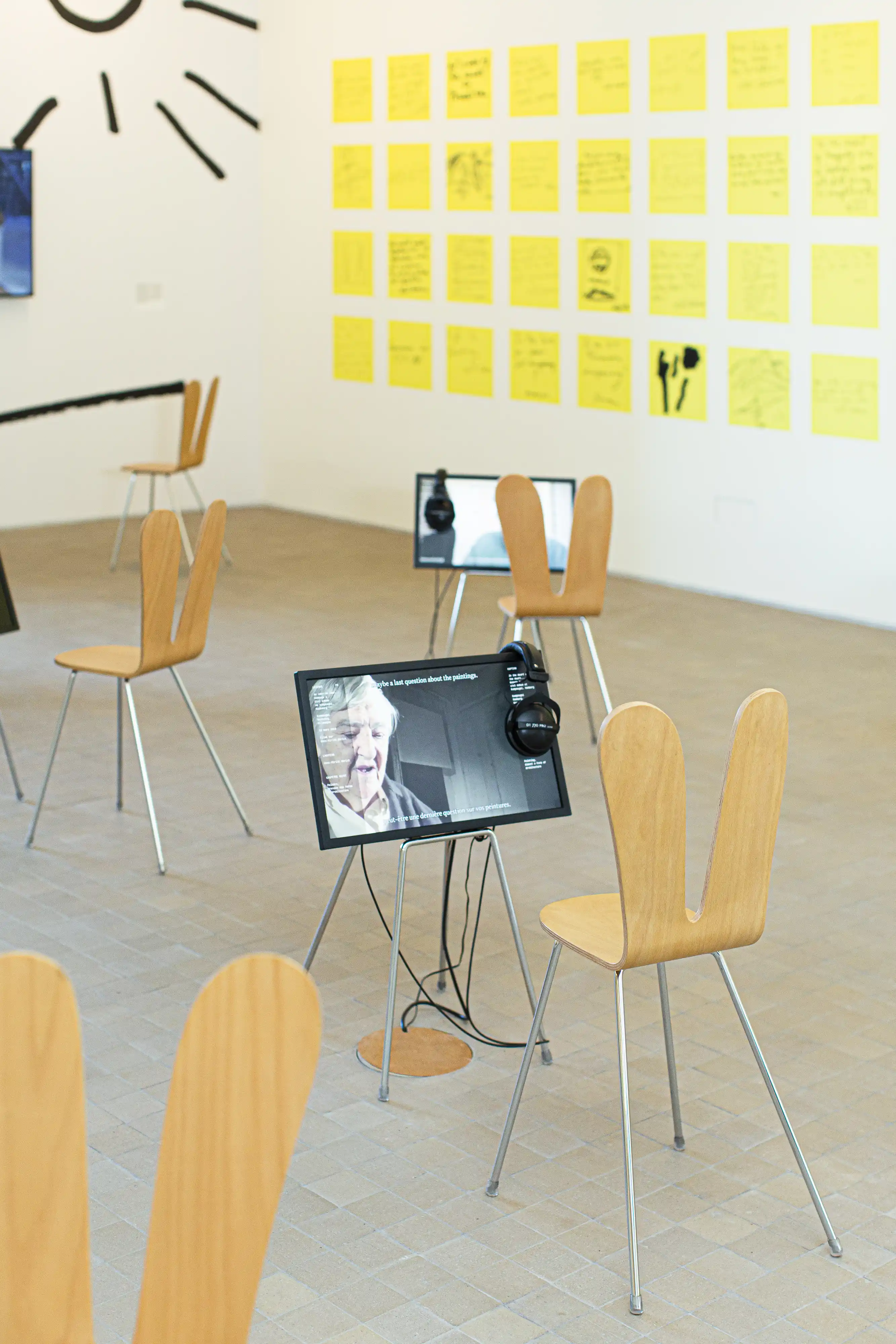
After a first chapter dedicated to Édouard Glissant, the second chapter of Hans-Ulrich Obrist’s archive focuses on the myriad of conversations with Etel Adnan from 2009 until her last days in 2021, offering fifteen hours of unreleased interviews, tracing their relation through hundreds of published documents, post-it notes, handwritten correspondences, and artworks. Their connection was one of mutual respect and, above all, wholehearted admiration. They shared numberless projects; she was a regular participant of the Marathon conversations, organised yearly by Obrist at the Serpentine, London; he devoted two major solo exhibitions to her practice and published multiple monographs. Adnan is an essential figure for LUMA in Arles, a project Hans-Ulrich Obrist has accompanied since its inception. Maja Hoffmann, founder of Luma, remembers: ‘Etel once told me, what we are doing with LUMA is creating a lighthouse for the Mediterranean. If LUMA is the lighthouse, then Etel is certainly the fire, the fire that lights up the space and shows directions.’

Etel Adnan - LUMA Arles - ©Victor&Simon - Joana Luz-2
Credits
©Victor & Simon - Joana Luz

Interview with Hans Ulrich Obrist about Etel Adnan

"I've been very fascinated by Etel from the very beginning. It was almost like an oracle to meet her."

Fifteen hours of interviews with Etel Adnan are being shown for the first time to the public. The numerous discussions between Hans Ulrich Obrist and Etel Adnan, testify above all the depth, the accuracy, and the longevity of their continuous exchange, from 2007 until her passing on 14 November 2021.
In this interview, Hans Ulrich Obrist talks about the exhibition devoted to this archive, which reveals Etel Adnan's many passions, from writing to drawing, from painting to poetry, and especially her love of the world

‘The world needs togetherness, not separation. Love, not suspicion.  A common future, not isolation.’

Etel Adnan, June 2016


‘Ever Etel Ever Adnan’

— Hans-Ulrich Obrist, February 2021

Inside Hans-Ulrich Obrist Archives - Chapter 2: Etel Adnan Exhibition
Etel Adnan - LUMA Arles - ©Victor&Simon - Joana Luz-3
Credits

©Victor&Simon - Joana Luz

Etel Adnan - LUMA Arles - ©Victor&Simon - Joana Luz
Credits

©Victor&Simon - Joana Luz

Etel Adnan - LUMA Arles - ©Victor&Simon - Joana Luz-5
Credits

©Victor&Simon - Joana Luz

Etel Adnan - LUMA Arles - ©Victor&Simon - Joana Luz-4
Credits

©Victor&Simon - Joana Luz

Etel Adnan - LUMA Arles - ©Victor&Simon - Joana Luz-1
Credits

©Victor&Simon - Joana Luz

ADNAN Etel_2_Courtesy Galerie Lelong & Co

Etel Adnan

Etel Adnan (1925-2021) was a Lebanese-American artist, poet and essayist, writing in French and English. Born in Beirut, she moved to Paris after a long period of residence in California. She began painting in the 1960s and her work has received international recognition since DOCUMENTA(13), in 2012. In 2014, she was invited to the biennial of the Whitney Museum (New York) and the Qatar museum of modern art, the Mathaf, which dedicated a retrospective to her, organized by Hans Ulrich Obrist. Since then, numerous museums (Bern, Luxembourg, San Francisco, Aspen, Lille, etc.) and art centres have devoted exhibitions to her. Adnan’s works appear in numerous collections, including the MNAM-Center Pompidou, Paris; Mathaf, Doha, Qatar; MoMA, New York; M +, Hong Kong; Royal Jordanian Museum, Amman; the Museum of Modern Art, Tunis; Sursock Museum, Beirut; Institute of the Arab World, Paris; British Museum, London; Tate Gallery, London; World Bank Collection, Washington D.C.; National Museum for Women in the Arts, Washington D.C.; as well as in many private collections. Photo credit: Courtesy Galerie Lelong & Co. Paris
Portrait Hans Ulrich Obrist - Small

Hans Ulrich Obrist

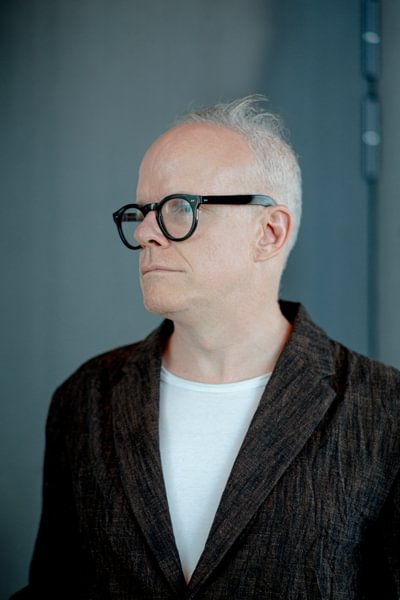
Hans Ulrich Obrist (b. 1968, Zurich, Switzerland) is Artistic Director of the Serpentine Galleries in London, and Senior Advisor at LUMA Arles. Prior to this, he was the Curator of the Musée d’Art Moderne de la Ville de Paris. Since his first show “World Soup : The Kitchen Show” in 1991, he has curated more than 350 shows.

 Obrist’s recent publications include Ways of Curating (2015), The Age of Earthquakes (2015), Lives of the Artists, Lives of Architects (2015), Mondialité (2017), Somewhere Totally Else (2018) The Athens Dialogues (2018), Maria Lassnig: Letters (2020), Entrevistas Brasileiras: Volume 2 (2020), and 140 Ideas for Planet Earth (2021).