Open |
Open from
Closed today
Ticketing
My selection

What Diane Arbus Wasn’t Doing (Part II) and How She Wasn’t Doing It

As part of the exhibition Constellation, dedicated to Diane Arbus, a conversation about her work will take place on July 8 with Neil Selkirk and Darius Himes.

Whatever strategies Diane Arbus employed as a photographer—and there were many, ranging from her approach to her choice of subject and equipment—were designed to liberate her from the need to control the image. She deliberately subordinated herself to meticulously devised techniques and the vagaries of chance, trusting her photographs to be more insightful than she believed herself (or anyone else) to be.

By placing her trust in the innate power and authority of the medium, she enabled her photographs to discover and record what she had never imagined.

What made her work so startling, singular, and socially disruptive was its seemingly straightforward technical and aesthetic approach to image-making, which appeared, at first glance, to be the product of simple objectivity. Yet it was—and continues to be—fundamentally different from, and even opposed to, the prevailing values of the art establishment.

This conversation is organized by Matthieu Humery, curator of the exhibition Constellation dedicated to Diane Arbus.

1920x1280_230619_LUMA_PROG_DIANE-ARBUS_TALK_VISUEL_DIGITAL-ASSETS_CD-2

[EXHIBITION] Constellation — Diane Arbus

After Diane Arbus’s death in 1971, Neil Selkirk began printing for the Arbus Estate and is the only person, since the artists’s death, authorized to make prints from her negatives.

The exhibition Constellation brings together all of the prints (some still unpublished) from the Selkirk set of 454 images in the form of an immersive installation.

251003_LUMA_COM&MARK_WEBSITE_ASSETS_PLACEHOLDER ARTISTS PAGE_08

Neil Selkirk

Neil Selkirk is a photographer and filmmaker. Shortly after he arrived in New York from London in 1970, he met Diane Arbus.

He took her master class and, after her death, wound up being the only person ever authorized to make posthumous prints of her work.

As a photographer, he has worked for virtually all the major US magazines. He has specialized in the creation of new publications, having been involved with the first issues and covers of Wired, Spy,Colors, Paper, and Vue.
He has published four books of photographs: 1000 on 42nd Street (2000), See No Evil (2006), Lobbyists (2007), and Certain Women (2015).

His photographs are in major US collections, including the Metropolitan Museum of Art in New York.
251003_LUMA_COM&MARK_WEBSITE_ASSETS_PLACEHOLDER ARTISTS PAGE_08

Darius Himes

Based in New York City, Darius Himes oversees a global team as the International Head of Photographs for Christie’s. Prior to joining Christie’s, Himes was director of Fraenkel Gallery, San Francisco from 2011 to 2014. In 2007, he co-founded Radius Books, a non-profit publisher of books on photography and the visual arts. A lecturer, writer, and contributor to various journals and publications, his 3rd edition of Publish Your Photography Book, co-authored with Mary Virginia Swanson, was just released this May 2023.
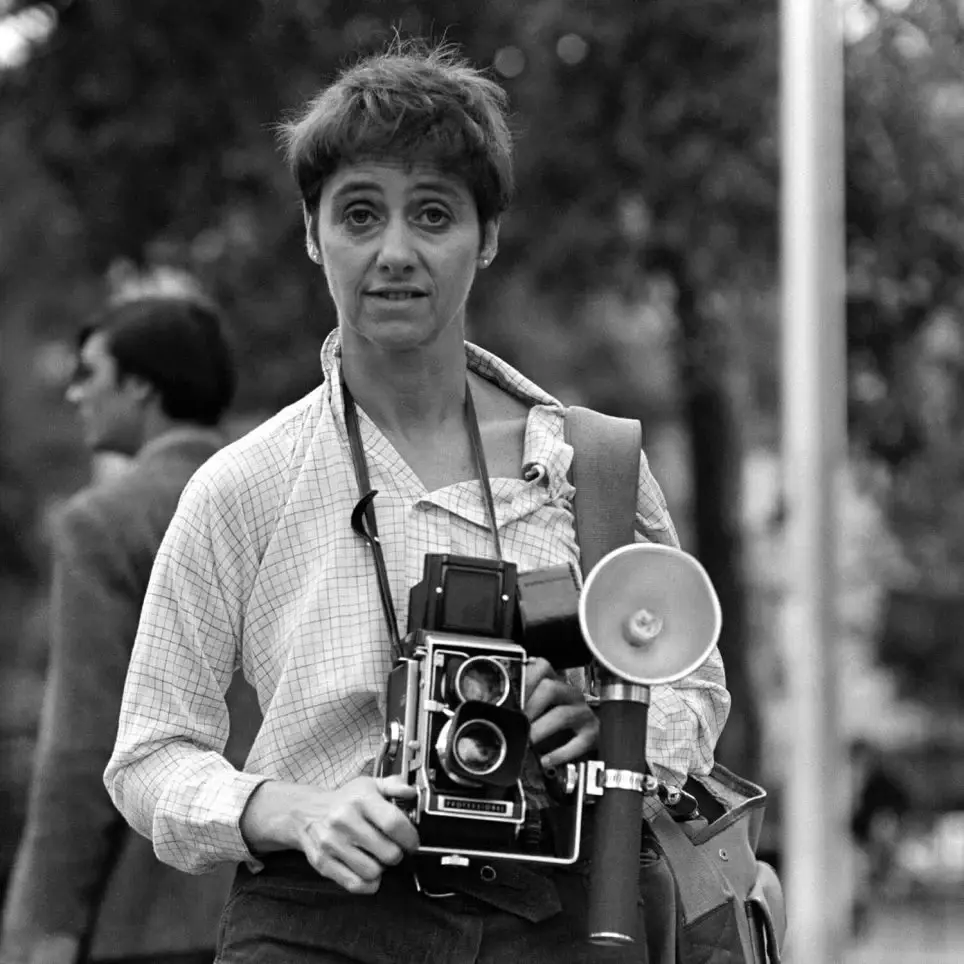
Diane Arbus photographiée en 1949

Diane Arbus

Diane Arbus is one of the most original and influential photographers of the twentieth century. She studied photography with Berenice Abbott, Alexey Brodovitch, and Lisette Model and had her first published photographs appear in Esquire in 1960. In 1963 and 1966 she was awarded John Simon Guggenheim Fellowships and was one of three photographers whose work was the focus of New Documents, John Szarkowski’s landmark exhibition at The Museum of Modern Art in 1967. Arbus’s depictions of couples, children, female impersonators, nudists, New York City pedestrians, suburban families, circus performers, and celebrities, among others, span the breadth of the postwar American social sphere and constitute a diverse and singularly compelling portrait of humanity. A year after her death, her work was selected for inclusion in the Venice Biennale, the first time any photographer had been so honored.

In the ensuing fifty years, major traveling museum retrospectives have been mounted by the Museum of Modern Art in New York (1972), the San Francisco Museum of Modern Art (2003), the Jeu de Paume, Paris (2011) The Metropolitan Museum of Art, New York (2016), and the Art Gallery of Ontario (2020).

Books devoted to her work include: Diane Arbus: An Aperture Monograph (1972), Magazine Work(1984), Untitled (1995), Revelations (2003), The Libraries (2004), A Chronology (2011), Silent Dialogues(2015), In the Beginning (2016), A Box of Ten Photographs (2018), and Documents (2022).

In addition to the museums mentioned above, significant collections of her work can be found in numerous institutions throughout the world. The Bibliothèque Nationale de France was an early collector, and the Centre Pompidou followed.